
Transforming How the World Understands Communities
May 6, 2026
In 2023, one of my colleagues shared the story of a woman living through the devastating impacts of climate change and her plea for help. Her situation became visible because ordinary people documented what they were experiencing and shared it in real time. Without that grassroots reporting, her story and the urgent needs it represented might never have reached decision-makers.
 Aerial View of Farmlands Near Lilongwe, Malawi (Image Credit: SINAL Multimédia)
The experience in the story reflects a broader pattern we have seen across Ushahidi deployments worldwide. Communities often signal distress early, but formal systems detect crises late. Another similar example is during Cyclone Freddy (Fact: This is the longest-lasting tropical cyclone on record according to the World Meteorological Organization), where community reports helped map impacts across Malawi, Mozambique, and Zimbabwe as events unfolded. Similar citizen-generated reporting supported situational awareness during floods in New Zealand and earthquakes in Turkey and Syria, where thousands of messages from affected people helped responders understand where assistance was most urgently needed.
For decades, governments, foundations, and humanitarian organizations have made billion-dollar decisions about communities using surprisingly thin evidence. Surveys arrive months late, and field reports often have to filter reality through multiple layers. Social media reflects only the connected few, yet the most urgent signals like fear, need, resilience, emerging crises, and even local solutions rarely reach decision-makers in time, if at all.
So what is Ushahidi doing about it? With support from mission-aligned partners, we are building Distant Voices as a platform to capture everyday feedback directly from people in their own languages and formats and turn it into structured insights institutions can act on. Instead of relying on periodic studies, Distant Voices continuously gathers input from channels communities already use, and on our part, we translate, transcribe, categorize, and analyze this information to surface patterns, risks, needs, and opportunities in near real time. The goal is to have more truthful data that is closer to the lived experiences of communities.
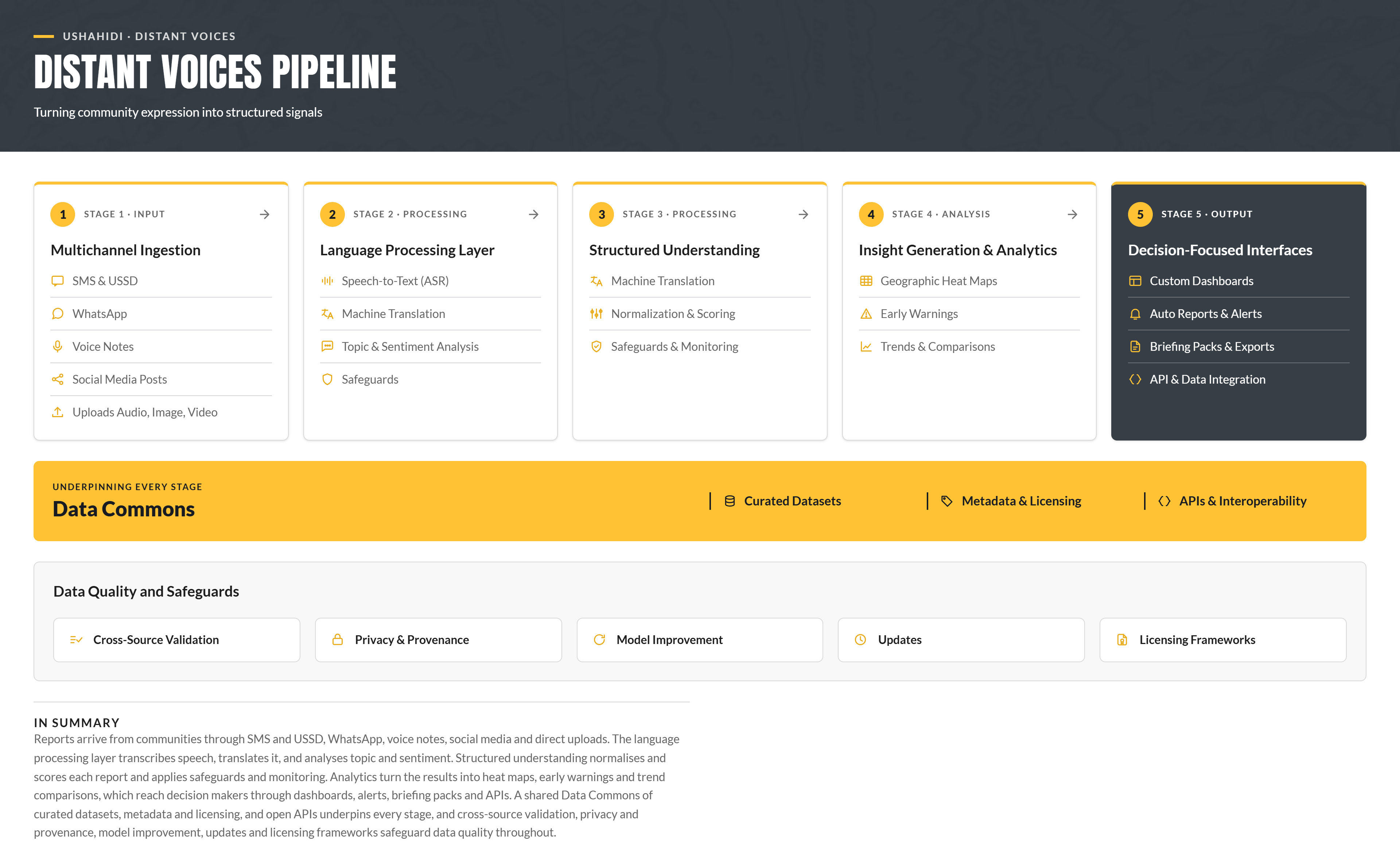
As illustrated above, technically, Distant Voices is a pipeline. Socially, it is a feedback loop between communities and institutions. Our team is working to deliver a platform that ingests messy real-world data, operates across languages and formats, protects privacy, and conveys insights that decision-makers can trust under time pressure.
From the vibrant open-air Bodija market stalls in Ibadan to the colorful graffiti-covered matatus in Rongai, communities are already telling us what matters through channels and languages often overlooked by formal systems.
Distant Voices is an attempt to ensure those voices are no longer distant.