

Listening to Climate Voices
How Communities Shaped Climate Action in Nigeria
In southwestern Nigeria, climate change is no longer abstract; it is lived with daily. Farmers in Osun face unpredictable rainfall and crop failure. Communities in Ondo endure recurring floods and environmental degradation. Residents in Oyo report rising heat and growing food insecurity. Yet despite these realities, community voices are often absent from formal climate planning.
The Nigeria Climate Action Project, implemented across Osun, Ondo, and Oyo States, sought to bridge this gap by enabling communities to share their lived experiences directly with policymakers.
A Partnership Grounded in Local Trust and Global Technology
The project brought together complementary strengths:
- NetHope provided funding and strategic oversight.
- YARN (Youth in Agroecology and Restoration Network) led local outreach and trust-building.
- Ushahidi delivered the digital platform and designed the data collection methodology.
This collaboration ensured that global technical expertise was grounded in local realities.
Methodology: Community Engagement Meets Digital Listening
The project adopted a hybrid model combining Social media listening and Structured surveys. At the heart of this approach was Ushahidi’s Distant Voices model, an innovative methodology that captures natural online conversations to include perspectives often excluded from traditional consultations.
By leveraging platforms such as Facebook, X (Twitter), YouTube, and Nairaland, Distant Voices generated real-time, unfiltered insights that complemented field data.
The results exceeded expectations:
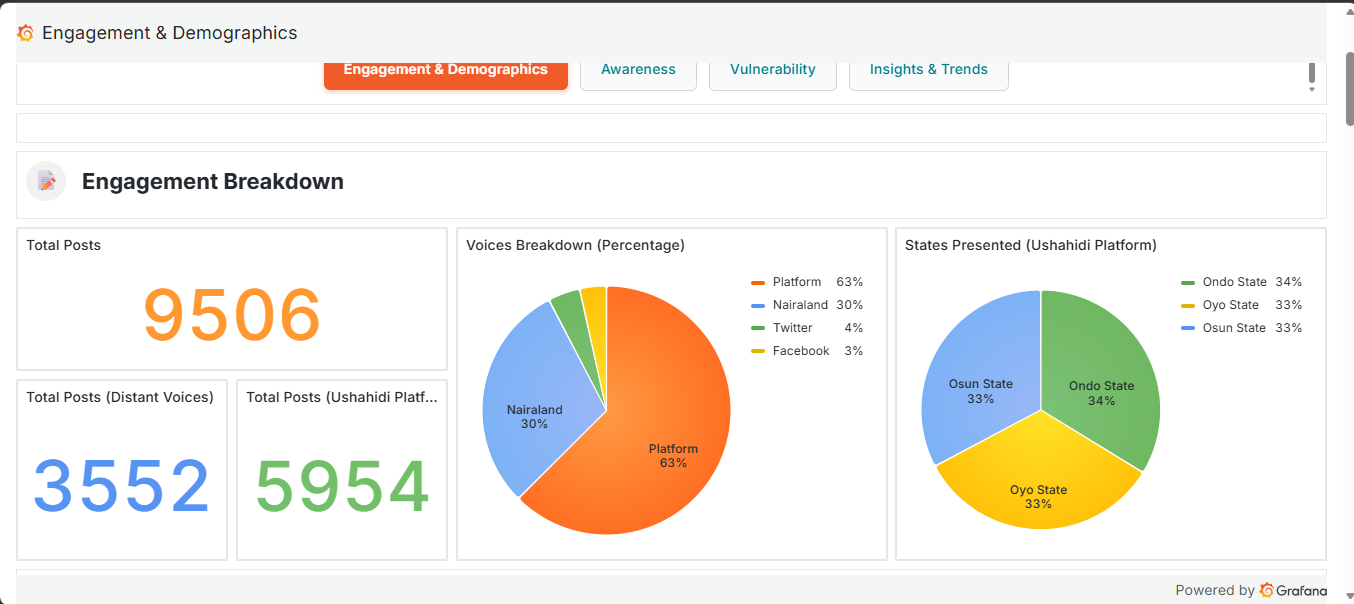
9,506 community-generated posts were collected — nearly double the original target of 5,000.
This demonstrated how hybrid models (offline + online) can dramatically expand reach and inclusivity.

What Communities Told Us
Across all three states, five consistent patterns emerged:
- Climate disruptions are intensifying: rising temperatures, erratic rainfall, flooding, and coastal erosion are disrupting agriculture, fishing, housing, and access to services.
- Vulnerable groups bear the greatest burden: women, children, older adults, and rural households face disproportionate impacts.
- Agriculture is under strain: traditional planting calendars no longer align with weather realities, increasing food insecurity.
- Environmental degradation worsens risk: deforestation, soil erosion, and water scarcity compound climate shocks.
- Social and economic pressures are deepening: rising healthcare costs, disrupted schooling, and shrinking incomes are creating cycles of precarity.
Climate change is experienced not as an environmental issue alone, but as hunger, displacement, lost income, and rising health risks.
Communities are Already Adapting
Despite limited support, communities are innovating:
- Farmers stagger planting seasons and experiment with drought-resistant crops.
- Households harvest rainwater and dig small reservoirs.
- Youth organize tree-planting campaigns.
- Communities increasingly adopt solar energy to cope with heatwaves and blackouts.
As one online post noted:
"Going solar in Nigeria is no longer about escaping bills, it's about surviving heatwaves and blackouts."
Yet adaptation remains fragmented and under-resourced. Communities repeatedly emphasized the need for:
- Early warning systems
- Climate-resilient agriculture support
- Local-language climate information
- Stronger environmental enforcement
- Inclusive climate governance
Cross-Learning Across Three Countries
Similar projects in Uganda (Yumbe District) and Kenya (Tana River and Siaya Counties) revealed striking parallels.
Despite differing hazards — drought in Uganda, flooding in Kenya, coastal erosion in Nigeria — the pattern was consistent:
Unpredictable climate → disrupted livelihoods → income loss → food insecurity → social strain → weakened trust in institutions.
Across all contexts:
- Women carried heavier water and caregiving burdens.
- Youth faced shrinking livelihood options.
- Persons with disabilities encountered evacuation barriers.
- Elderly farmers struggled as traditional climate knowledge became unreliable.
One overarching lesson emerged:
Climate resilience begins with listening.
When communities co-design tools and validate findings, trust increases, and data becomes more actionable. When hybrid data models combine offline engagement with digital listening, representation improves. When insights are translated into risk maps and policy briefs, lived realities shape governance conversations.
Technology proved to be a bridge, not a substitute for institutions, connecting citizen knowledge to policy processes.
Conclusion
Climate resilience in southwestern Nigeria depends on elevating community voices into formal governance systems. Farmers, women, and youth are already adapting, but without coordinated support, financing, and institutional backing, their efforts remain constrained.
The Nigeria Climate Action Project demonstrates that participatory technology, local partnerships, and AI-supported social listening can transform grassroots insights into actionable climate intelligence.
By embedding inclusive, community-driven data systems within state planning frameworks, Nigeria can strengthen early warning systems, promote equitable adaptation, and build more resilient local livelihoods.
Link to the full project report: https://drive.google.com/file/d/1V-BKjtbSZK3Lj46jCu3BX1ajHJgiHJVz/view?usp=sharing
9506
Total Posts
5954
Total Posts (Ushahidi Platform)
3552
Total Posts (Distant Voices)
Published Evidence
- Deployment Link
Ushahidi Platform
- Distant Voices Dashboard
Distant Voices
- Full project report